


Gordon Wu
-
Posts
9 -
Joined
-
Last visited
Gordon Wu's Achievements

Newbie Scroller (2/11)
2
Reputation
-
 Wichman reacted to a post in a topic:
Varying Radius When Cutting With Flying Dutchman Superior Puzzle Blade Issue
Wichman reacted to a post in a topic:
Varying Radius When Cutting With Flying Dutchman Superior Puzzle Blade Issue
-
 Hmm...my bad...I mis-read the message about sanding the backside corner. I'll try that when I have time. I ran a quick experiment to see how tight of a radius I can cut with various tension on the Hegner saw. See below for the results: I started at 3/4 of a turn of tension...made a cut by turning clockwise by 90 degrees then counterclockwise by 90 degrees. Then I made cuts with higher and higher tension. For the cuts, I tried to minimize the twist I see in the blade. I almost never see twists in the blade when I'm turning the wood clockwise, and as you can see in the pictures, the cuts were tighter as I racketed up the tension. But the counterclockwise turns remained about the same in terms of the radius. Is that from bad technique? This is using a new FD superior puzzle blade. I tried to minimize the cuts so that the blade isn't worn down from one tension setting to the next and I used the same blade for all the cuts. I'll try to sand the backside corner and repeat the test again. But appreciate any feedback. Thank you!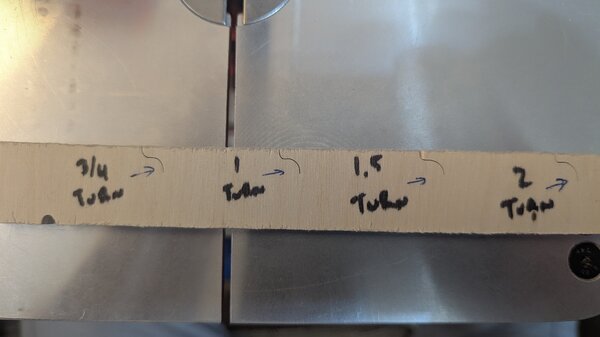
-
Alright, here to report back on my experiment with sanding the FD superior puzzle blade. I tried it out a little bit...keeping the sand paper on the side while running the saw, or gently pressing on the blade at a 45 degree angle from the side. The results are the blade just stopped cutting through the 1/4" baltic birch. I would have thought the sanding would sharpen the blade but it somehow dulled the blade. But it was a fun experiment on a Sunday afternoon
-
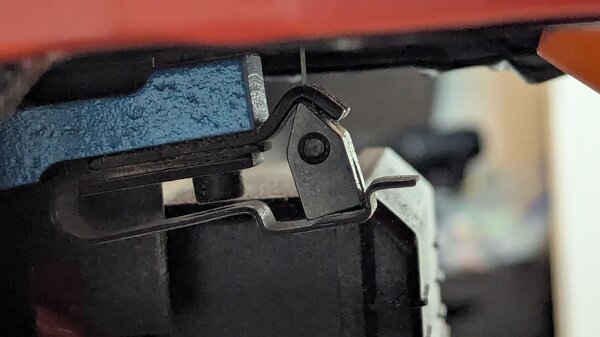
Okay it's been a couple of week since I've had significant amount of time with the saw. I've played with different tension settings on the Hegner saw. Below is a picture of the bottom blade holder: The picture isn't completely leveled but you can see the blade holder is tilted one direction. I realize that happens more when I have more than 1 turn of tension. The strange thing is it's not always tilting. And whenever I see it's tilting, I try to push it back to being straight but after cutting for a little bit, I'd check and the holder is tilted again. When I see that, the blade ALWAYS looks like a hockey stick at the end. Regarding on-the-spot turning, I don't know why I can't do that. And it is always when I'm trying to rotate the wood counter clockwise. I have no problem turning clockwise. It doesn't help that it varies from blade to blade even within the same pack. These are the Flying Dutchman Superior Puzzle Blades. I've gotten to the point where I would mount a blade and cut a radius on a piece of scrap wood...and if it doesn't cut well, I just put the blade in the scrap pile and try a new one. I'm averaging one blade out of every 4-6 blades that I'm setting aside. I'm not saying the blades are bad, just not sure if I'm not mounting them right or the tension is wrong or something else I'm doing wrong. And this is all using 1/4" baltic birch plywood. I read that it may be part of how a blade is made...there's burrs on one side? I can definitely feel more tug when I run my fingers on the right side of the blade compared to the left. I guess that may explain why it cuts better when I'm turning clockwise vs counter clockwise. I'll get some fine sand paper and try sanding down a few pieces to see how that goes. Also, I've been running my saw at a speed of 700-900. There was once when I had the saw faster than 1400 and the blade broke and all the rattling spooked me so I haven't tried going so fast again. But I'll try again and report back! As a side note, I got some 1/8" basswood plywood just to play around. It cuts like a hot knife through butter. I can also get a tighter turn...not sure if it's due to the thinner wood or softer wood. But it doesn't feel as substantial...sturdy as the 1/4" baltic birch.
-
 OCtoolguy reacted to a post in a topic:
Varying Radius When Cutting With Flying Dutchman Superior Puzzle Blade Issue
OCtoolguy reacted to a post in a topic:
Varying Radius When Cutting With Flying Dutchman Superior Puzzle Blade Issue
-
Thank you all for the encouragement. It's the bottom of the blade. I will try 6/4 of a turn. At first, I wasn't keeping track and wasn't re-tensioning it after every time I put on a new blade...then when I started doing that and realize there's some variation on how much tension there is when I install a new blade...is that because I'm not consistent in the length of blade that's getting clamped? I'm going to cut some more puzzles this weekend and see how it works out and report back! Thank you all!
-
 OCtoolguy reacted to a post in a topic:
Varying Radius When Cutting With Flying Dutchman Superior Puzzle Blade Issue
OCtoolguy reacted to a post in a topic:
Varying Radius When Cutting With Flying Dutchman Superior Puzzle Blade Issue
-
OCtoolguy reacted to a post in a topic:
Varying Radius When Cutting With Flying Dutchman Superior Puzzle Blade Issue
-
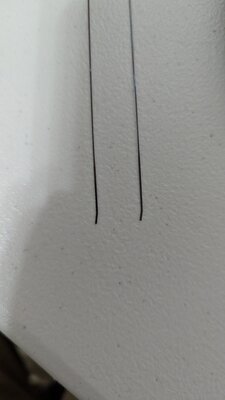
Thank you. I didn't know the clamp size made a difference...I also didn't know I was using the medium clamp...I'll switch it out for the small clamp. A week ago (half way into my experimentation), i changed out the top clamp for the QuickClamp. Any thought on the usage of the QuickClamp for the 2/0 blade size? I haven't kept track of how many breaks I got but it's always breaking at the bottom since I started using the QuickClamp and the blades look like the picture below when I changed it out (when it's not breaking). The teeth are to the left of side of the blade in this picture. And the breaks are always the size of that bent piece...I have to push it out of the clamp with another blade. I'm using the FD Superior Puzzle Blade. I just don't know if the blade flexing so much is normal...I get kind of nervous whenever the blade flex so much...combined with a moving saw, it becomes a huge distraction while I'm cutting. Then my cuts get wonky because I'm so nervous the blade will break. Thoughts?
-
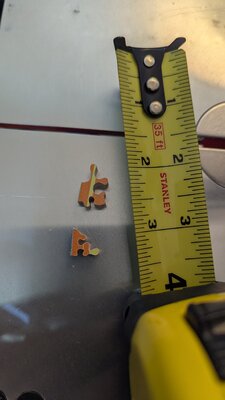
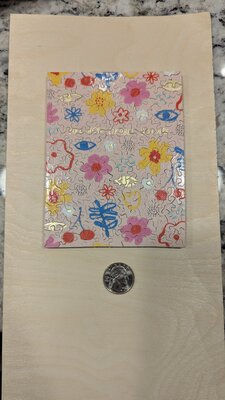
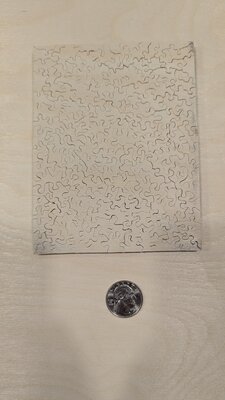
New to cutting with a scroll saw. I've had about maybe 15-20 hours total on the scroll saw. Cut a couple of small christmas cards into puzzles using the Flying Dutchman Superior Puzzle blade on 1/4" baltic birch. One thing I have a hard time controlling and it seems to vary from blade to blade is the radius of my cuts. There are some blades I can cut a very small radius at first...then the radius gets really big or I can see the blade clearly not pointed straight...like it's bent 45 degrees or more to the side. And it is almost always when i'm rotating the wood clockwise. You can see in the picture in the attached image with the measuring tape that there's a top piece with a really big radius in the cut. Then the same piece got a lot smaller radius in the cuts. Is that just bad technique? Or is it easier to cut when turning counter clockwise because the left side of the blade is sharper for some reason? Is it okay when the blade is bending 45 degrees? Is there a general rule on the minimum radius for a cut vs the width of the blade or wood hardness/thickness? Am I simply cutting my pieces smaller than I should? I've read the thread about 5 and 10 reasons for broken blades...for the life of me, I can't seem to tell if the tension is too tight...hard to tell. I'm using a Hegner scroll saw and I'm adjusting the tension with the knob in the back...any clue if 2 complete turns is too much or too little? I'm cutting at 900-1100 SPM...the blade kept breaking when I was running it much faster than that. Does the saw speed impact how tight of a turn I can make? Also attached is the first puzzle I cut. The cuts are kind of random...wasn't following any lines or curves...just cut it as I felt like it at the moment. Appreciate any feedback / critique on the work and how to improve. Thanks! Gordon
-
Thanks for the notes Kevin and John T. It's interesting you mention the blades dulls quickly on Baltic Birch and needs a lot of blades for each puzzle. So...let's say it's the size of that dollar bill puzzle and that's a what...5 x 12 piece puzzle on that Baltic Birch...6 mm? I understand it'll vary depending on the wood and thickness and everything but how many blades does it take to do something like that on average? Trying to grasp the order of magnitude to stock up on...if it makes sense to buy a dozen or 10 dozens at a time. It's interesting you mention the plywood gets rougher over time because it's absorbing moisture. So in general...do you need to pre-treat the wood if it's been sitting in a high humidity environment...like the summer heat in Florida by heating it up in an oven or something to bake off excess moisture before starting? And let's talk about cutting wood pieces. Maybe I'm just not good with cutting wooden items because whenever I cut something, I never can get the cut to be the dimension I measured and marked. How do you cut to the exact size...without being slightly too small or too big? As in, a dollar bill is a very exact size, how do you cut it so that the dollar bill fits perfectly on there? Do you cut a rectangle out of sheet metal and file it down to the exact shape and then use that as a guide to cut your blanks? And if so, how would you cut a blank something like a photo? Do you need to cut a piece of sheet metal as a guide for every photo size so that the blanks don't end up being too big or too small when you glue on the photo? Triple thick clear glaze acrylic spray vs flat lacquer...is the type coating a matter of preference? What purpose does it serve? Is it to minimize oil from dirtying the puzzle after being played with a few times? Does it help hold the photo from detaching from the wood? Is there other considerations for acrylic vs lacquer? John T...is that a real benjamin that you cut up? Or TWO benjamin's even? If so, that's some confidence and real dedication to the craft.
-
Ahh. Interesting. I'm leaning toward small puzzles like the dollar bill puzzle shown above by JTTHECLOCKMAN. Another question, would you need to sand down the Baltic Birch before gluing the picture onto the wood? I've read it helps with the picture adhering but not sure how important it is. I'd prefer not getting equipment that I won't actually need. Good to know that a sander may mess up the front side. Didn't think about that. So it sounds like Baltic Birch won't generate fuzz if cutting with a puzzle blade...is it the flying Dutchman puzzle blade or are there other brands that's similar? And does it have to do with the TPI or the shape of the teeth? What causes and how to minimizes fuzz when cutting? I'm happy to go experiment but it's be good to learn from the collective knowledge of the community so I have an idea what has and hasn't worked. Thank you for the thoughtful responses!
-
Hi all, I've been interested in learning how to cut puzzles from 1/4" plywood. I've read a bit, watched some videos, but before I make purchases and start getting hands on experience, I got a question. I hear about sanding the pieces down after cutting. Are the pieces sanded individually? If so, is it typically done using a sanding mop? Or is the puzzle assembled and turned around so the picture is facing the table and the entire backside is sanded together? Is it using a random orbital sander in that case? I'm trying to understand the process to understand the overall scope of equipment needs before getting permission. Thanks! Gordon


