Wichman
-
Posts
1,978 -
Joined
-
Last visited
-
Days Won
48
Content Type
Store
Profiles
How-To & Articles
Scroll Saw Reviews
Clubs & Organizations
Clubs & Organizations International
Pattern Shop
Suppliers
Village University
Help Desk
Forums
Gallery
eBooks
Everything posted by Wichman
-
that's the one
-
I am starting a new pattern/project; the frankenswitch from Gizmos and Gadgets. Has anyone here made one of these? Are there any tip, tricks, or advise about pitfalls? Thanks Wichita
-

Asking for advice with my Delta 16in blade clamps
Wichman replied to Archer's topic in General Scroll Sawing
I still have and use the two speed model of that saw. IMHO that is the best blade clamping system ever devised for scroll saw blades; BUT it is a royal PIA to change blade sizes. I do 90% of my cutting with one size and type of blade and that probably explains why I think it's so good. The Pegas style clamps are not compatible with the quick clamp, at least not without a machinist degree. The Delta has a single attachment point and the Pegas has two. The replacement clamp that the Artisan Pirate shows in his video no longer exists on Amazon, and Amazon doesn't have anything similar. If you have metal working experience you could make an adapter yourself; 3/16" bar stock, hole drilled in the top, drop down 1/2" twist stock 90 degrees, form a v in the bar, cut a notch for the blade in the front of the V. use a blade holder such as the Hegner style clamps, clamp fits in the V.- 4 replies
-
- 3
-

-

-
- delta
- blade clamp
- (and 1 more)
-
Paul, It's not the different time zones. When I got my e-mail (g-mail) it was at 5:04 am, I immediately logged into the village, and then looked at your message, the time stamp read "Posted 3 hours ago". On all the messages just to the right of the screen name is a little blurb indicating when the message was posted, not a time and date stamp, but a "this long ago" indicator. I am just curious, that's why I asked for someone with experience in this sort of thing to respond It's all good, just my curiosity again
-
I got my e-mail notification at 5:04 am and so I came to the Village to share, and found that Fab4 had posted this 3 hrs before (as shown by the Village system). So, this begs the question; why did I get my e-mail 3 hrs after Fab4? I realize that SG has an extensive e-mail list and there may be limits his provider has put on him, i.e. only x number of e-mails sent per x amount of time. Does anyone in our community have any insight into how this works on large scale e-mailings, inquiring minds want to know.
-
Definitely a SG pattern, search for "penny"
-
You could try the "command" strips, they make a very small one and if you incorporated the small pull tab into the design...
-
JT, He is looking for something that can be removed and replaced without damaging the item(s). My search was focused on that. Within the link are options that are stick-on. The reviews on the item I linked to are quite positive about the Velcro adhesive being quite tough with the Velcro being easy to get on and off. The reviews on your link, while very positive ( 5 stars ) they also state that the Velcro is also quite strong and the the top covering tore while being removed. This is why I bellyached about the search engines, even the "ask rufus" feature on Amazon was having troubles finding answers to "strong adhesive, light duty Velcro" queries.
-
Great idea! Since you're selling so many to the wife's coworkers, maybe you could make a couple for the boss's use: "wonder woman" and "superman" for employee of the month ( or other phrases as needed) . Eye of Sauron (knockoff) and the list goes on.
-
I found these: https://www.amazon.com/dp/B0888K6PD2?niid=nl_cl_lst_a_0_1&ref_=nl_cl_lst_a_0_1&nrid=3V95RTJCPDWSSNPG75WY&th=1 on Amazon ( good grief, the search engine are now almost useless). They seem to be what you are looking for, and it would be inexpensive to try a package to see. Note to Travis: I tried to use the word substitution for hyperlink in the message body, but it would not work.
-
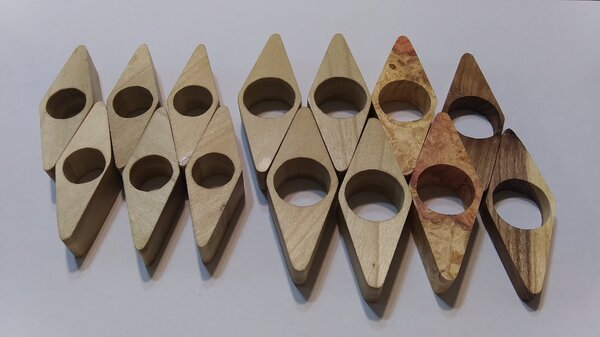
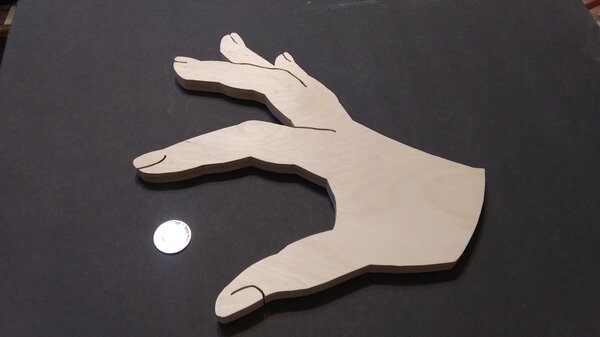
Using Google, search for "thumb book holder template". I just used Steve Good's pattern, they sold well, but I ran out of figured wood, the plain Jane wood sold so-so. I had so many people ask "what is it" I enlarged a Steve Good pattern of a hand so that it would hold the book open; sigh, had someone who wanted to buy the hand (face palm).
-
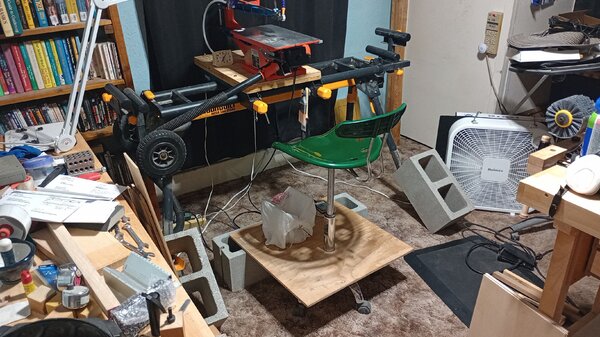
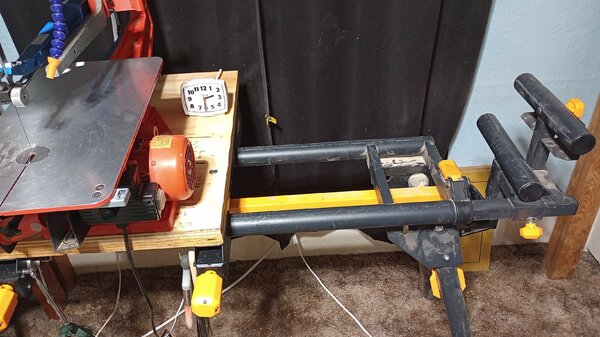
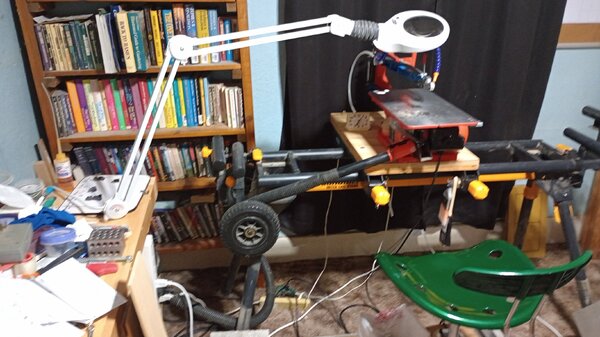
After looking at the way I had my house and indoor shop configured, I decided to move things around a bit (a lot). Some pictures of the work in progress. I finally mounted the Hegner to the miter saw stand. The thing I paid the most attention to was the center of balance; when I unbolted the saw from the factory stand, I slid a dowel under the saw and marked where the center of balance was on the saw, then I made sure the COB was centered on the stand. There is enough space on either side to mount the other two saws I have. Utilizing the stand allows me to make my equipment more modular and flexible. I've found that my larger shopvac is much less annoying than the smaller one, so I can have it running while cutting. The clock on the left tracks the time the saw runs (it's connected to the foot switch); the clock on the right tracks how long a project takes to cut
-
- 6
-
-
I used Inkscape to simulate the colors, yes, a darker stain would look nice. Nice cutting.
-
I've got a new one going: URAQT "You aRe A cutie (QT)"
-
Just saw this on the Steve Good website and wanted to share: Update on Steve: This is only the second time in 19 years I have ever posted on his website without his permission, but I have his phone with me, and your emails of concern and caring are overwhelming, so I wanted to give an update: yes, he is doing well, but he has had a really rough week. From Sunday in the ER with pneumonia, it went into total respiratory failure and he was placed on a ventilator and into ICU. Thankfully, after 3 days, he came off the ventilator yesterday and is back awake and talking with Kellie and I. He remains in ICU with the plan that the cardiologist will place stents on Monday to repair the heart damage. Beyond that, I have not even ventured to ask - we still have to deal with his ankle surgery healing as well. Please continue to pray for him and for us. I am staying here at the hospital with him. Also, this is very isolating for him - if you would like to send him a card to the house, Kellie is going by and collecting the mail for me - I think he would enjoy that! I am keeping his phone away from him or he would be worried about working Thank you for your continued thoughts and prayers. Love, Patty Good and family.
-
Here you go. Gun cabinets, trigger locks, etc.
-
Well the test is complete... and is a complete failure. When I first pulled the trivets out of the "press" they were completely flat, but within minutes they returned to the original warped state. They are still perfectly good trivets and at 7/16" thickness they should protect the surface underneath from hot pans.
-
Very nice, good to see the Bauer saw is working out for you.
-
Favorite Projects 2025 - Scroll Saw Challenge
Wichman replied to Travis's topic in General Scroll Sawing
- 31 replies
-
- 3
-
-
- scroll saw challenge
- challenge
- (and 3 more)
-
Favorite Projects 2025 - Scroll Saw Challenge
Wichman replied to Travis's topic in General Scroll Sawing
Bravo, sir, bravo.- 31 replies
-
- 1
-
-
- scroll saw challenge
- challenge
- (and 3 more)
-
A similar pattern from the library: And another:
-
My one question is: can you install the rotary tool upside down? I have an application where is would be necessary.
-
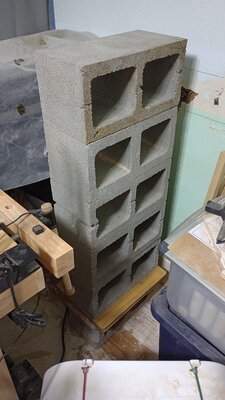
Yesterday I started the test. I used my countertop roaster oven and used walnut cooking oil. I had enough oil to just cover the 1/2" wood. I started at 200 degrees and let the temperature stabilize in the cooker. Next I raised the temperature 25 degrees every 15 minutes until I got it to 300 degrees, then let the wood "cook" for two hours. After the two hours were up I moved the trivets to the "press"; one cinder block on the bottom, one bamboo cutting board, then the trivets, another cutting board, and finally five cinder blocks stacked on top. I'll give it five days to stabilize before I check for flatness.
-
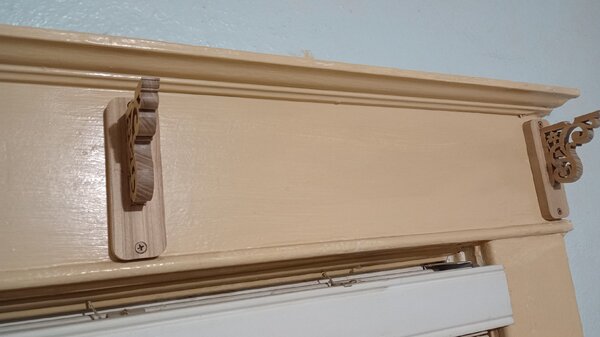
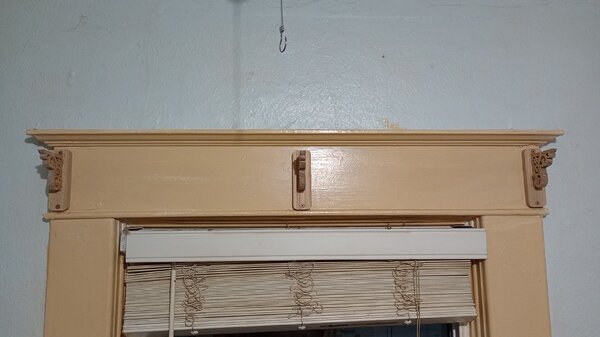
Yes, they are fancy, but not overly so. Here's a couple pictures of them installed. I'll pull them down after it warms up enough and apply BLO.